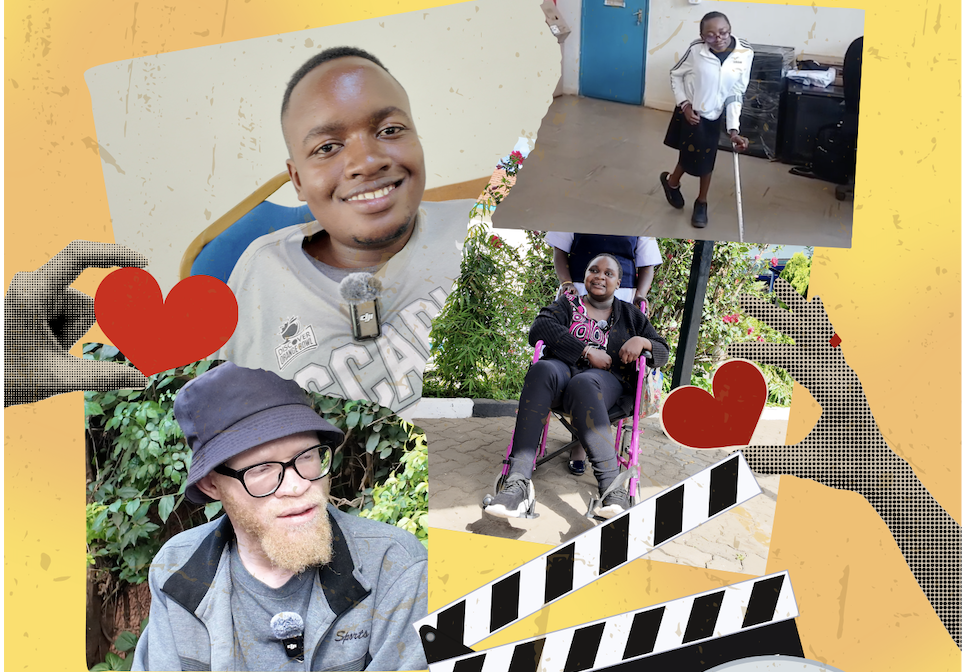
My interest in persons with disabilities was inspired by a multimedia project that began as a collaborative assignment. In seeking to understand the lived experiences and rights of persons with disabilities, as enshrined in Article 54 of the Constitution of Kenya, I met Meshack Sisena, a person with albinism and a committed communications staff member at ANDY (Action Network for the Disabled ) an organization recognized by the National Council for Persons with Disabilities (NCPWD).
Meshack is also a singer and an active member of a local disability rights group. He helps coordinate events and identify talent within the community. He recounted his journey from intern to staff member at ANDY, highlighting the importance of access to education and opportunities, values protected by the Constitution. Meshack, who holds a diploma in communications, urges persons with disabilities (PWDs) to seek support rather than hide or resort to street begging, echoing the NCPWD’s message on empowerment and inclusion.
Through ANDY, individuals with various disabilities receive training to navigate the world independently, in line with their skills and in accordance with the constitutional guarantee of equal treatment and access. During our interview at their Kibera offices, Meshack shared that their organization is focused on inclusion and trains people with diverse abilities. They currently have a cohort about to be released, already trained in various aspects.
At the Kenya Institute of Mass Communication, I met James, Vera, and Benjamin Mulwa, students at the institution, each with unique experiences of disability. James and Vera were both born without hands, while Benjamin is paralyzed from the waist down and uses crutches. Their stories reflect resilience, determination, and the promise of Article 54(1), which guarantees access to education and training for persons with disabilities. Through their interviews, I witnessed their passion for learning and how their unique abilities allowed them to excel among their peers.
James, despite the challenges, is deeply passionate about technology and journalism. He taught himself to write and perform spoken word using his legs, demonstrating the spirit of self-reliance promoted by the National Council for Persons with Disabilities.
Vera is an enthusiastic advocate for PWDs; she encourages others with disabilities not to hide or feel ashamed, reminding them that disability is not a barrier to participation or success, in accordance with constitutional values. She stresses the importance of embracing one’s situation and maintaining a positive outlook for mental health.
Benjamin’s love for football began in childhood and continued despite his disability. He shared his struggle with mental health after being placed in a special school and his subsequent advocacy, which led to mainstreaming and infrastructural improvements at his new school—changes that reflect the constitutional right to reasonable access and accommodation. Inspired by this support, Benjamin formed a team for students using wheelchairs, fostering inclusion and empowerment as championed by NCPWD.
“As members of society, it is our collective responsibility to provide Persons with Disabilities (PWDs) with the support and opportunities they need to achieve their aspirations. “
The individuals highlighted above have powerfully demonstrated that disability is not inability. Though differently abled, they have shown remarkable resilience and continue to challenge and redefine perceptions of disability. Their stories remind us that true inclusion means recognizing the strengths and contributions of every individual, and ensuring that everyone has the chance to pursue their dreams.

A very powerful and informative piece. It beautifully highlights that ability goes far beyond physical limitations. The experiences of Meshack, James, Vera, and Benjamin clearly demonstrate that disability does not define one’s potential. Thank you for shedding light on such important and inspiring narratives.
This piece really touched me. It highlights the importance of inclusion and recognizing the abilities in every person.